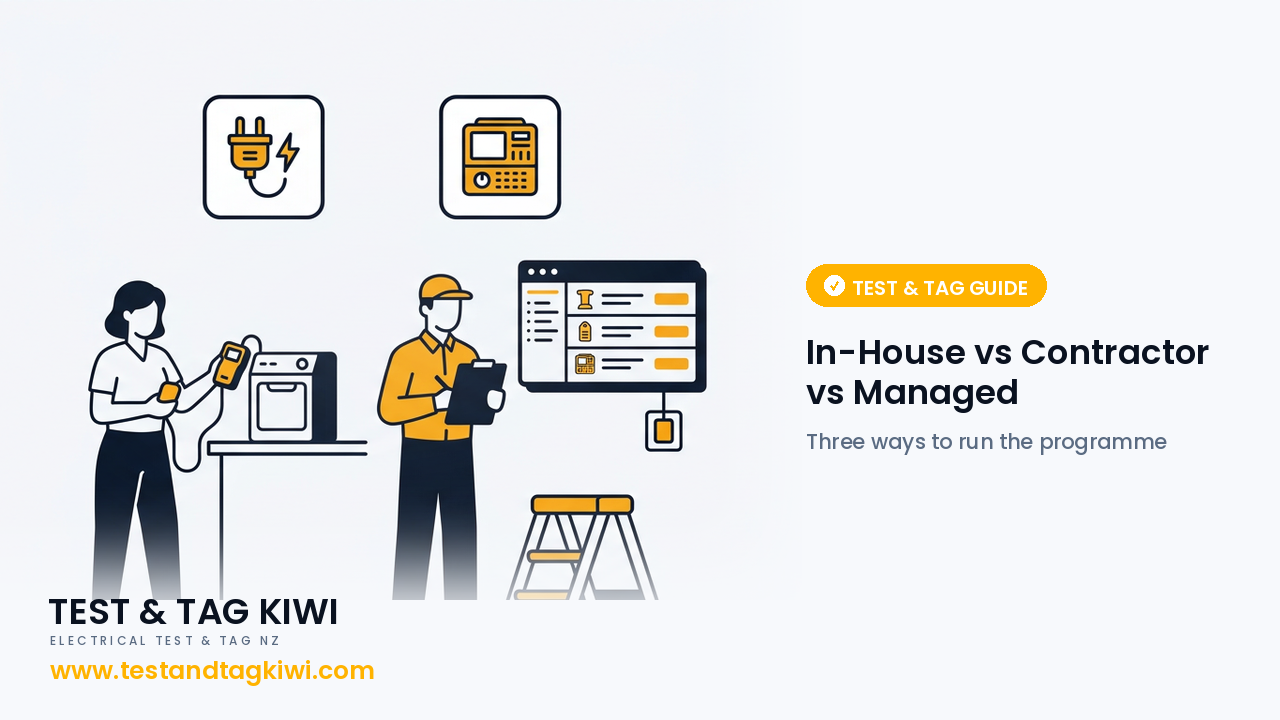
Most New Zealand businesses reach the same point: the equipment register exists, someone has asked who is going to do the testing, and three options appear. You can train someone in-house, book a contractor on a schedule, or hand the whole programme to a managed service.
All three are legitimate. They differ in who carries the administration, how much control you keep over timing, and what breaks first when the business changes. This guide compares them on the things that actually decide the outcome: the register, the records, and what happens when an item fails.
The three models, briefly
- In-house: you buy or hire a tester, nominate a competent person, and run the inspection, testing, tagging and records yourself.
- Scheduled contractor: an external tester attends on an agreed cycle, tests what is presented, tags it and reports back. You keep the register and the programme.
- Managed service: the provider owns the register, the schedule, the tagging, the reporting and usually a portal or dashboard. You keep the duty to act on what it finds.
What New Zealand law does and does not say
Testing and tagging is not mandatory in New Zealand. What is legally required is that electrical equipment is electrically safe and maintained in a safe condition. That duty sits with the person conducting a business or undertaking under the Health and Safety at Work Act 2015, and it does not move when you engage someone else to do the testing.
AS/NZS 3760 is a standard, not legislation. Following it is one accepted way to show that equipment has been inspected and tested on a defined cycle, and it is the reference most providers work to. It is not the only possible method, and it is not a legal instrument in its own right.
Two things follow. No model is "the compliant one" — each is a different way of meeting the same duty. And whichever model you choose, you remain the party who has to be satisfied that equipment is safe, so the strength of the records and the defect process matters more than the logo on the tag.
Repairs sit outside all three models. Faulty equipment has to be repaired as prescribed electrical work by an authorised person, then retested before it goes back into use. How that hand-off works is worth agreeing before you choose a provider — see what happens when equipment fails a test.
Option one: in-house testing
What in-house testing actually requires
Testing is the small part. The programme is the work.
- A competent person. AS/NZS 3760 expects the person carrying out the testing to have the knowledge and experience to test correctly and to interpret the results, including knowing when a reading means "do not return this to service".
- A test instrument with current calibration. A pass or fail result from an uncalibrated tester is not evidence of anything. Keep the calibration certificate with the records, not in a drawer.
- Time. Each item needs inspection, testing and tagging, plus movement between rooms, floors or buildings. Across several hundred items a year, that becomes a real labour line rather than a spare-hour task.
- Records. A per-item record with a unique identifier, location, test date, result, tester and next due date — retained and retrievable when someone asks for it months later.
- Tags and a defect process. Failed items removed from use, tagged out, repaired and retested before return.
- Coverage of change. New purchases, hired gear and staff-owned items have to enter the register, or the programme quietly goes stale between rounds.
If you are starting from nothing, the sequence matters more than the equipment: define the register and the records first, then decide who tests. Setting up a test and tag programme covers that order, and asset register management is the piece most in-house attempts skip.
Where in-house works well
A single site with a steady asset base, a workshop or maintenance team that already owns equipment checks, and someone who can be released for a day each cycle. It works best when the tester uses the instrument often enough to stay fluent and when the register is maintained as a living document rather than rebuilt each year.
Where it strains
Multiple sites, high equipment turnover, seasonal peaks, or one person carrying testing as a side task alongside their real job. The common failure is not a bad test — it is a register that stops being updated, and records that leave with the person who kept them. Buying a tester before defining the programme is the classic order-of-operations error, and it usually shows up two years later as an incomplete register.
Competency is also a live question rather than a one-off: can I test and tag my own equipment sets out what "competent" means in practice.
Option two: a contractor on a scheduled visit
This is the middle path most businesses land on. A tester attends monthly, quarterly or annually, works through the items presented, applies tags and leaves a report.
What you still own
The register, the decision about what is in scope, site access and escorts, and acting on failures. A contractor tests what is in front of them; they cannot test equipment that is locked in a van, off site for repair, or in a room nobody opened. Coverage is your problem, not theirs, unless the arrangement says otherwise.
Where a contractor model fits
Concentrated sites, a moderate item count, predictable equipment and a site manager who can keep the register current between visits. It also suits businesses that want an external, consistent testing method without buying instruments or carrying calibration themselves.
Where it quietly fails: nobody adds new assets between visits, failures are tagged but not actioned, the annual report goes to an inbox nobody owns, and changing providers leaves the history split across two sets of PDFs. None of those are reasons to avoid the model — they are clauses to write into it.
Option three: a managed service
What "managed" should mean
- The provider builds and maintains the register, with unique identifiers and often QR labels on each item.
- Testing is scheduled and rolled out across sites, including after-hours access where the site needs it.
- Every item produces a retrievable record, searchable by asset identifier and by site.
- Reporting covers coverage, failures and remediation status, not just a list of passes.
- There is a defined process for adding new assets and retiring disposed ones.
Where a managed service fits
Multiple sites, thin administrative capacity, high equipment turnover, or a construction environment where equipment arrives and leaves weekly. Those are the cases where the register is the hard part and where an internal owner is least likely to keep it current — see running a multi-site programme and the multi-site dashboard for what the reporting side looks like.
Two things to test before signing. First, data ownership and exit: can you export the full register and the item history, in a form you can use elsewhere? Second, the failure path: what is the committed response when an item fails, and who physically removes it from service. A managed service that tests well but leaves failed items in the tea room has moved the paperwork, not the risk.
Comparing the three models
- Register ownership: you (in-house), you (contractor), provider with export rights (managed).
- Administrative load: highest in-house, moderate with a contractor, lowest with a managed service.
- Control over timing: highest in-house, shared with a contractor, provider-scheduled when managed.
- Continuity through staff change: fragile in-house, stable with a contractor, stable when managed.
- Multi-site reach: hard in-house, workable with a contractor, built in for a managed service.
- Typical failure mode: the register drifts in-house, coverage gaps appear between visits, or exit terms are weak when managed.
Five questions that decide it
- How many items are in scope, and how many are added or leave each month?
- How many sites are there, and how far apart are they?
- Can you release someone for a testing day each cycle, or genuinely not?
- Who will act on a failed item within a day, and where will it be stored until it is repaired?
- Who needs the records, in what form, and how quickly can they produce them?
If the answer to question four is "nobody, yet", no model will fix that. Remediation is a client-side responsibility in every arrangement, and it is the part providers cannot do for you.
The non-negotiables in every model
- A unique identifier per item, tied to a location.
- Inspection and testing to AS/NZS 3760 at a cycle appropriate to the environment.
- An instrument with a current calibration certificate that you can see.
- A tag showing the test date and the next due date.
- Records retrievable per item and per site, kept for as long as you may need to demonstrate the equipment's history.
- Failed items removed from use, with a defined repair and retest path.
- A named owner of the programme inside your own business.
The standard itself is worth understanding rather than delegating entirely — AS/NZS 3760 explained is the plain-language version. On the records side, compliance reporting and record keeping cover what to retain and how to make it stand up later.
Common mistakes when comparing providers
- Comparing price per item without comparing scope. One quote may include the register, tagging, after-hours access and reporting; another may be testing only. The line items are not the same product — what drives test and tag cost explains why.
- Treating the tag as the record. A tag on a plug says an item was tested; it does not give you a history you can produce on request.
- No internal owner. Every model assumes somebody on your side adds assets, books access and chases failures.
- Assuming outsourcing transfers the duty. It transfers the testing task, not the obligation to keep equipment safe.
- Choosing from a walkthrough instead of a sample report. Ask for a redacted report from a real site and read it. It tells you more than any sales conversation.
What to ask a provider before you sign
- Which standard do you test to, and what does your method actually record?
- Can I see a redacted sample report for a site like mine?
- Who owns the register, and can I export it in full if we part ways?
- How are new assets added between scheduled visits?
- What happens, step by step, when an item fails?
- How do you handle after-hours access and multiple sites?
- What is explicitly excluded from the scope?
Making the decision
In-house suits a single site with a steady asset base and someone who can own the programme properly. A scheduled contractor suits concentrated sites with moderate counts and a manager who will keep the register current. A managed service suits multi-site operations, high turnover and businesses without spare administrative capacity.
Hybrids are common and sensible: a managed register and reporting layer with contractor visits, or in-house testing at the main site with a provider covering the branches. What matters is that one model owns the register and one person owns the programme internally.
If you want help working out which model fits your sites, request a quote or talk to us about your equipment list. If you are still working out what the testing covers, start with what test and tag is and the complete compliance guide, or look at our test and tag service.