What a multi-site test and tag programme really involves
If you look after electrical safety across more than one building, you already know the hard part is not the testing itself. It is keeping one coherent programme running across sites that have different equipment, different managers and different priorities. A workshop in Onehunga, a row of retail units in Hamilton and an office floor in Wellington may all sit under the same facilities management contract, but the electrical equipment in each looks nothing alike.
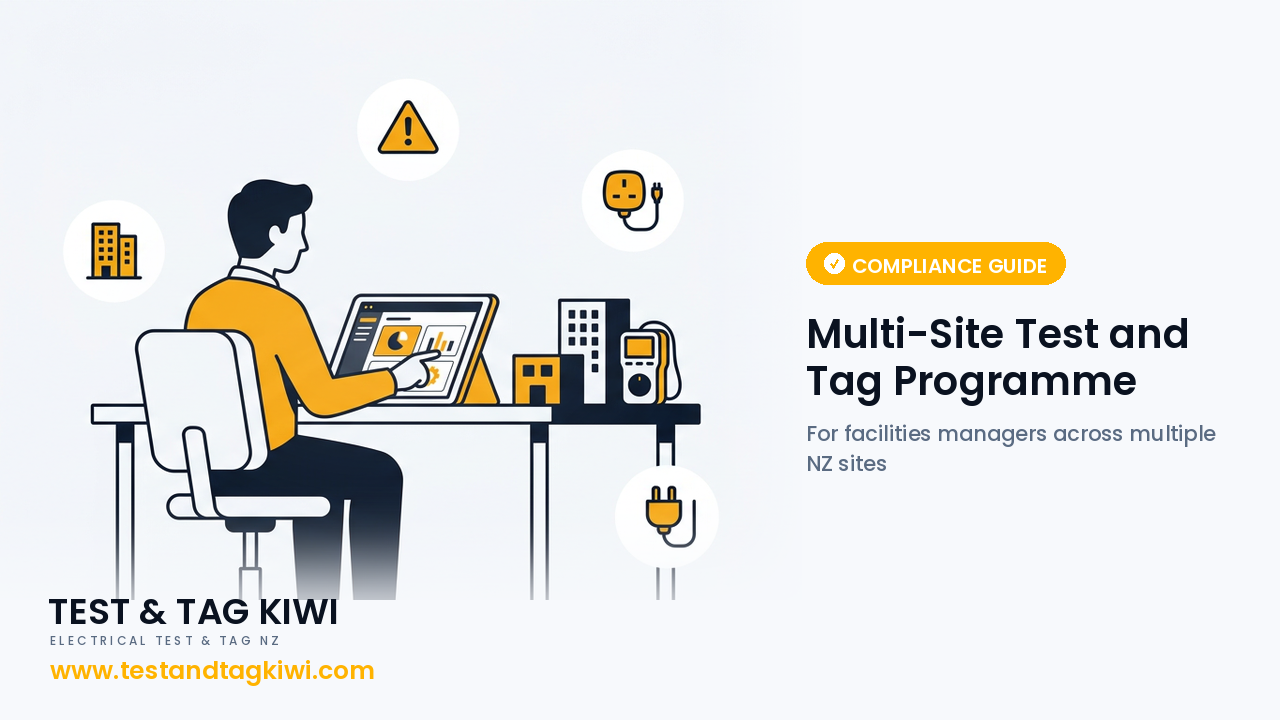
A multi-site test and tag programme is the set of decisions and records that ties those sites together: one way of identifying equipment, one schedule for inspecting and testing it, one set of records, and one person accountable for the whole thing. Get those four elements right and electrical safety stops being a scramble before a client audit or a WorkSafe visit. Leave them to chance and each site drifts its own way until something goes wrong.
This guide is written for facilities managers, asset and property managers, and operations leads who coordinate electrical safety across multiple locations in New Zealand. It is about how to run the programme, not how to perform a test.
Why multi-site is different from testing a single building
Testing one site is largely a logistics exercise. You book a technician, they walk the building, they tag what they find, you file the report. Across multiple sites the same task becomes a coordination problem, and four differences do most of the damage.
- Nobody sees the whole estate. Each site has a local manager who knows their own equipment and nobody else's. Without a shared register, equipment quietly accumulates, moves between rooms and disappears from the list.
- Access windows differ. A warehouse can be tested during a quiet afternoon; a school only during holidays; a restaurant only before service. A single national schedule rarely fits them all.
- Records fragment. One site keeps a paper log, another emails a PDF, a third relies on the testing provider's own system. Rolling those into one view of compliance becomes a manual job every time it is asked for.
- Cost and travel multiply. Poorly grouped visits mean paying for travel between sites rather than for testing, which is the part that actually keeps people safe.
If you are still setting up your first programme, the fundamentals are covered in how to set up a test and tag programme for your business. The rest of this article assumes that foundation exists and focuses on scaling it.
What the law does and does not require across your sites
The single most useful thing a facilities manager can do is keep four ideas separate: law, standard, guidance and best practice. They are routinely blurred together in online advice, and the distinction decides where your budget should go.
The law in New Zealand is the Health and Safety at Work Act 2015 and the Electricity (Safety) Regulations 2010. The duty they place on a person conducting a business or undertaking is that electrical equipment is electrically safe and maintained in a safe condition. There is no legal requirement to test and tag, and that is true whether you run one site or fifty.
Testing and tagging is one recognised way of checking that equipment is safe. AS/NZS 3760 is a Standard — a method a business can choose to follow so that inspection and testing are done consistently and the results mean something. WorkSafe New Zealand publishes guidance describing testing and tagging as a useful check rather than an obligation. Everything else — how often you test, what you test first, how much you document — is a decision you make based on your equipment and risk profile.
That framing matters at scale. Because testing and tagging is not itself a legal duty, a multi-site programme is not about proving obedience to a rule. It is about demonstrating, site by site, that you are managing electrical risk deliberately. A well-run programme is evidence of that; a folder of expired tags is not. For the technical detail behind the Standard, see AS/NZS 3760 explained for New Zealand workplaces and what test and tag actually involves.
Start with one asset register across every site
Everything else in a multi-site programme depends on the asset register. If you cannot list the equipment you own, you cannot schedule its testing, budget for it, or prove it was done.
A workable register records, for every item: a unique identifier, a plain description, the site and room it lives in, the person or team responsible for it, the interval that applies to it, the date it was last inspected and tested, and the date it is next due. The identifier is the part most teams get wrong. A tag number that is unique across the whole estate — not just within one building — is what lets you move equipment between sites without losing its history.
Two practical aids make this survive contact with reality. QR asset tracking lets a technician or a site manager scan an item and see its history instantly, which is far more reliable than a hand-written label. And a central asset register management service keeps the register current as equipment is bought, retired or transferred, rather than letting it decay into a spreadsheet nobody trusts.
Set intervals by risk, not by a single rule of thumb
A common mistake at scale is to impose one interval on every item everywhere. A desk lamp in an air-conditioned office and a power tool used outdoors on a construction site do not carry the same risk, and treating them identically wastes money on the first and under-protects the second.
AS/NZS 3760 suggests intervals for common equipment types and environments, and many businesses adopt those suggestions as their starting point. What they choose to follow is a business decision, not a legal one, and the intervals should reflect how and where each item is used. Equipment in a hostile environment — dust, moisture, heavy use, movement — generally needs attention more often than equipment that sits still in a clean, dry room. A structured electrical risk assessment is the cleanest way to justify the intervals you choose, site by site, and to show a client or auditor why they are reasonable.
Scheduling and batching across locations
Once you know what you have and how often it needs attention, scheduling becomes an exercise in grouping. Two rules pay for themselves quickly.
First, batch by geography. Testing sites that sit close together in the same visit, or the same week, cuts travel time and cost and makes a single national rollout far easier to manage. A programme covering Auckland, Wellington and Christchurch can be sequenced region by region rather than site by site.
Second, fit the schedule to each site's access reality. Confirm quiet periods, shutdowns, holiday closures and shift patterns before you book anything, and give site managers enough notice to move equipment into an accessible space. Aligning electrical testing with other planned maintenance visits is often the difference between a programme that runs smoothly and one that is constantly being rescheduled.
Coordinating contractors and in-house staff
Multi-site programmes usually involve a mix of people: a testing provider, local site staff who know where the equipment is, and a central coordinator who owns the schedule. Whoever carries out the work, three things keep quality consistent across every location.
- One method. Every tester should follow the same procedure and record results the same way, so a report from one site is directly comparable with another.
- Competent people. Testing involves electrical work, and the person doing it needs the knowledge and skills to judge whether equipment is safe — a point explored in can I test and tag my own equipment?.
- A single point of contact. One coordinator, one booking process and one place for site managers to raise issues. A customer portal that shows every site's status in one view removes most of the back-and-forth.
Where you use an external provider, look for workplace test and tag services that already work across multiple sites and can report centrally, rather than a patchwork of local providers with no shared system.
Records, reporting and proving the programme
Records are where a multi-site programme either earns its keep or falls apart. What you keep, and how you keep it, is what turns individual test results into evidence that you are managing electrical safety across the whole estate.
Keep the same records at every site: what was inspected, what was tested, the result, the date, who did the work, and what was done with any item that failed. Store them centrally rather than on each site's own drive. The principles are set out in test and tag record keeping for NZ businesses and in more depth in compliance reporting best practices.
Centralised records make reporting straightforward. Instead of chasing spreadsheets, a multi-site dashboard can show, at a glance, which sites are current, which are overdue and where failures have clustered. A structured compliance reporting service and digital reports turn that data into something you can hand to a client, an insurer or a board without a week of preparation. When an item does fail, knowing what happens next — described in what happens when equipment fails a test and tag — should be part of the programme, not an afterthought.
Prioritising when you cannot test everything at once
Few programmes start with a complete register and an unlimited budget. If you have to sequence the work, prioritise by risk rather than by site seniority. Equipment used by many people, equipment in wet or dusty environments, portable tools that are moved and knocked about, and anything in a high-traffic public area should come first. Fixed, rarely used equipment in a controlled office environment can wait.
Documenting why you chose that order is itself useful. It shows that the sequence was a considered decision about risk, which is exactly what the duty to keep equipment safe asks of you.
Common pitfalls in multi-site programmes
- A register that only exists on paper. If it is not updated when equipment moves or is retired, it stops reflecting reality within months.
- One interval for everything. Convenient, but it overspends on low-risk equipment and underserves high-risk equipment.
- Records scattered by site. The moment you need an estate-wide view, the cost of gathering them outweighs the value of the testing itself.
- No single owner. When responsibility is shared across sites, it usually ends up belonging to nobody.
- Treating testing as the goal. The goal is safe equipment. Testing is the check; what you do with a failure is what protects people.
Getting started: a practical checklist
- Agree who owns the programme centrally, and name a contact at each site.
- Build one asset register with a unique identifier per item, covering every site.
- Set intervals by equipment type and environment, and record the reasoning.
- Group sites by geography and align visits with each site's access windows.
- Standardise how results are recorded, and store everything in one place.
- Review the dashboard and reports on a fixed rhythm, and act on what they show.
If you would like help building or consolidating a programme across your sites, you can request a quote or get in touch with our team to talk through your estate.