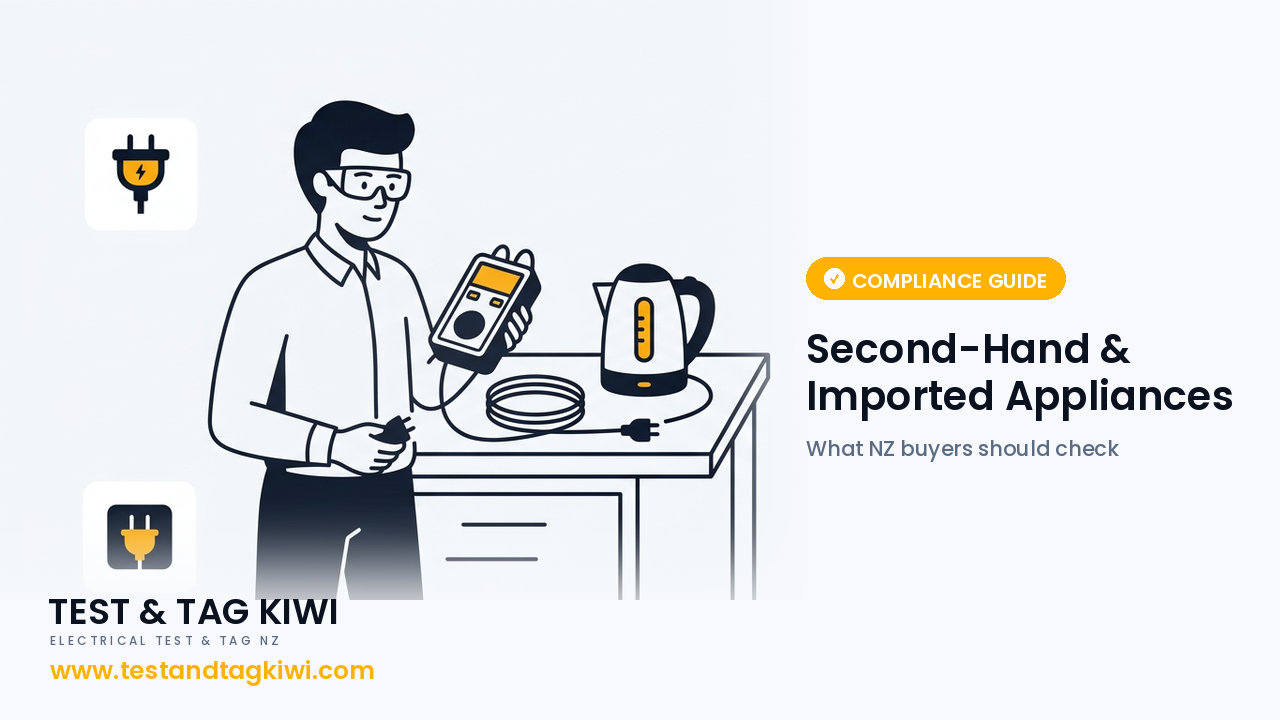
Why second-hand and imported equipment needs a closer look
Most electrical equipment in a New Zealand workplace arrives with a story you already know: bought new from a supplier, commissioned, added to the asset register. Second-hand and imported equipment breaks that chain. A used bench grinder from a farm shed, a pallet of ex-lease heaters, a machine imported directly from an overseas manufacturer — each arrives with an unknown service history and, in the import case, a design basis built for a different electricity supply.
That matters because the safety duty does not reset when equipment changes hands. A person conducting a business or undertaking (PCBU) has a duty to keep electrical equipment provided for work electrically safe and maintained in a safe condition. That duty follows the equipment, not the invoice. Whether an item was bought new, bought at auction, imported directly or handed over from another department, the same question applies: can you show it is safe to use here?
This guide covers what to check before money changes hands, what to do before first use, and how imported and second-hand items fit into an existing testing programme.
Law, standard, guidance and practice are four different things
Buyers often collapse these into one idea of "compliance", which leads to the wrong questions. Keep them separate:
- Law. The Health and Safety at Work Act 2015 sets the primary duty. The Electricity (Safety) Regulations 2010 apply to appliances, leads and hand-held tools connected to electricity.
- Standard. AS/NZS 3760 covers in-service inspection and testing of electrical equipment. It is a Standard a business can choose to follow as one way of showing equipment is safe. Product safety requirements for household and similar appliances sit in a different family of Standards, the AS/NZS 60335 series, which is about how an appliance is built rather than how it is checked once in service.
- Guidance. WorkSafe New Zealand publishes guidance on testing and tagging, including its position that testing and tagging is not mandatory and is one useful way to check equipment is safe.
- Practice. Your own programme: what you inspect, how often, who tests, and what you record.
That distinction is why a pass on a test set does not fix an imported appliance that was never designed for New Zealand conditions. In-service testing answers "is this item safe right now". It does not answer "was this item built to a recognised product standard, with a compliant plug and the right voltage rating". Both questions matter when the equipment is new to you.
Voltage and plug type: the most common import failure
New Zealand supplies electricity at 230 volts, 50 hertz, through the AS/NZS 3112 three-pin plug. Appliances built for other markets are built for other assumptions, and the mismatch is not cosmetic.
- 120-volt equipment from North America or Japan will not run correctly on 230 volts. Connected directly, it is a fire and shock risk. A plug adapter changes the shape of the pins; it does not change the voltage.
- Plug adapters are the single most common mistake. They convert pin geometry only. Everything downstream — insulation, switchgear, motor, heating element — still sees 230 volts.
- Step-down transformers can supply 120-volt equipment from a 230-volt supply, but they add another item of equipment to manage, protect and test, and they do not correct frequency differences. A 60-hertz motor or clock on a 50-hertz supply will run at the wrong speed.
- Non-standard plugs — UK, European, US or Australian types — need to be replaced rather than adapted if the appliance is to be used as workplace equipment. Have a registered electrical worker fit the correct plug; polarity and earth continuity are not things to get approximately right.
The same caution applies to the humble end of the market. Imported phone chargers, USB power supplies, power boards and extension leads are a well-known category of counterfeit and non-compliant product, and they are exactly the items people buy in bulk from online marketplaces without a second thought.
What the markings and paperwork should tell you
Before an appliance enters your workplace, its label should answer four questions: what it is, who stands behind it, what supply it expects, and what it is rated to do.
- Rating label. Voltage, frequency, current or wattage, model number and serial number. If the label is missing, unreadable or clearly belongs to a different item, treat that as a stop sign rather than a minor blemish.
- Supplier identification. A New Zealand or Australian importer, distributor or manufacturer named on the product or in its documentation. Appliances sold across both markets commonly carry the Regulatory Compliance Mark, which indicates the supplier has declared conformity with the applicable requirements. That mark is a claim by the supplier rather than a personal guarantee, but its absence on an imported appliance is worth asking about.
- Instructions. A manual that matches the model, in English, with the rated supply stated. Be cautious of a manual for a different model bundled with the unit.
- Plug and lead as supplied. An original moulded plug matching the market the appliance was built for. Cut, taped or re-terminated leads on a used item suggest a history you cannot see.
None of this substitutes for a physical inspection, and a label can be misprinted or copied as easily as paperwork can. What it does is separate a supplier who can answer questions from a listing that cannot.
What to inspect before you buy
A torch and five minutes will eliminate most bad purchases. Inspect in this order, because a visual defect can rule an item out before any electrical test is worth doing.
Plug and cord
Look for cracks in the plug body, bent or discoloured pins, a missing or loose earth pin, a lead that is cut, scraped, taped or stiffened by heat, and strain relief that has pulled out of the plug or the appliance. A lead that has been shortened and re-terminated informally is a repair waiting to happen.
Casing, controls and ventilation
Check for cracks, missing covers, loose switches, controls that do not move freely, and blocked or melted ventilation grilles. Discolouration around vents points to overheating. On anything stored in a shed or garage, look for rust, water staining and insect nests inside the casing.
Rating label and markings
As above: voltage, frequency, rating, model. Equipment with no label cannot be matched to a manual, an accessory set or a spare part, and it gives a tester nothing to record against.
History and previous environment
The environment an item worked in matters more than its age. Equipment from a farm, a boat, a workshop with metal dust or a construction site will have had a harder life than the same model in an office. Ask where it was used, what it was used for, and whether it has been repaired. Vague answers are information too.
Accessories and guards
Missing guards, fences, blades, hoses or attachments are a common reason used equipment becomes an expensive project. For appliances with a water connection, check seals and hoses; for anything with a guard interlock, confirm the interlock still operates.
A "tested and tagged" claim is not evidence
Used equipment listings frequently describe items as tested and tagged. That phrase means very little without the record behind it. Ask for the test date, the result, what was tested and who did it. A tag from another country, a tag with an illegible date, or a tag applied by an unknown provider tells you nothing you can rely on. Tag colours vary between providers and are not a reliable indicator on their own.
Even a genuine recent test is a point in time. WorkSafe's guidance makes the point directly: testing and tagging provides a snapshot of how safe an appliance is at the time of testing, not a guarantee of future safety. For equipment with an unknown history, the sensible reading of a recent test is "this may be a reasonable starting point", not "this is cleared for use".
Before first use: a baseline inspection and test
Once the equipment is yours, give it a baseline before it goes into service. This is the step that converts an unknown item into a recorded asset.
- Visual inspection. Repeat the pre-purchase inspection properly, in good light, with the item unplugged. Include the inside of the plug if it is re-terminable, and the full length of the lead.
- Electrical test appropriate to the class. For Class I equipment that normally means earth continuity and insulation resistance. Class II (double-insulated) equipment has no protective earth to test, so insulation resistance is the core check. The Class I vs Class II comparison explains the difference in detail.
- Functional check. Confirm controls, switches, interlocks and indicators work as intended, and that the appliance performs its function without unusual noise, heat or smell.
- Record the result. Asset identifier, description, location, test date, result, tester and next due date. That record becomes the first entry in the item's history.
If an item fails, take it out of service, label it clearly and either have it repaired by a registered electrical worker or dispose of it. Repairing faults is electrical work, and only a registered electrical worker should be doing it. A failed item that drifts back into the pool because nobody labelled it is a predictable failure mode — the failed-equipment procedure covers how to handle it.
Records are what turn a test into a programme
A test with no record is a conversation. A record is evidence. For second-hand and imported equipment the record matters more than usual, because there is no supplier history to fall back on.
Keep, at minimum: a unique asset identifier, a description, the location the item is used, the test date and result, the name of the tester, the next due date, and any repairs. Digital records with photographs of the label and the plug are cheap to produce and settle arguments quickly. The record-keeping guide sets out what is worth retaining and for how long, and the digital reporting and QR asset tracking services show how that works in practice.
Second-hand equipment to leave on the shelf
Some items are not worth the assessment. Walk away from:
- Anything with no rating label, or a label that clearly belongs to a different item.
- Equipment with a cut, taped or re-terminated lead and no record of who did the work.
- Plugs with a missing earth pin, a cracked body or evidence of overheating.
- Casings with cracks near mains wiring, missing covers or scorched ventilation.
- Items showing water damage, heavy corrosion or mould inside the casing.
- Equipment with guards removed, safety devices bypassed or interlocks defeated.
- High-current appliances of unknown provenance — heaters, kettles, welders, large extension leads. The consequences of a fault scale with current.
- Very old equipment where the insulation, cable or capacitors are likely to have degraded, unless it is being bought for parts.
Consumer purchases and workplace purchases are treated differently
If you are buying for personal use, the Consumer Guarantees Act 1993 applies: goods must be of acceptable quality and fit for purpose, and the supplier has obligations if they are not. A business buying equipment for work sits largely outside that consumer framework; the deal is governed by contract and by the Fair Trading Act 1986, which prohibits misleading conduct. Practically, that means the due diligence sits with you. Neither framework turns a seller's reassurance into a safety assessment.
Fitting imported and used equipment into an existing programme
There is no need for a separate programme for second-hand or imported items. Use the same risk-based logic you apply to everything else: what the equipment is, where it is used, how hard it is worked, and what condition it is in. A common approach is to inspect and test an unfamiliar item before first use, then place it on the same cycle as comparable equipment in that environment. If the first cycle is clean and the item lives in a benign location, it can settle into the normal rhythm; if it works outdoors, on a site, or in a workshop with dust and vibration, keep the frequency where the environment demands.
If you are still building the programme itself, setting up a test and tag programme walks through scope, frequency and record design, and what test and tag actually involves is the plain-language starting point. For AS/NZS 3760 as a Standard, see the AS/NZS 3760 resource and the practical compliance guide.
Questions worth asking before you pay
- What supply is this appliance rated for, and does it match 230 volts, 50 hertz?
- Is the plug the original moulded plug, and does it match the New Zealand type?
- Can you show me the test record, not just the tag?
- Where was this used, and has it been repaired?
- Are the guards, attachments and manuals included?
- Who is the New Zealand or Australian supplier, and can I get parts?
If the seller cannot answer these, the price is not the real cost. A cheap item that needs a new lead, a new plug and a repair by a registered electrical worker often costs more than a used item with a documented history, and more again than a new one with a warranty.
Where to get help
If you have a mixed fleet of new, second-hand and imported equipment, an inspection can sort it into three groups quickly: safe to use, needs repair, and retire. Book an on-site test and tag visit or request a quote, and if you would rather understand the requirements first, the frequently asked questions cover the common cases.