Why port and logistics sites need their own approach to electrical safety
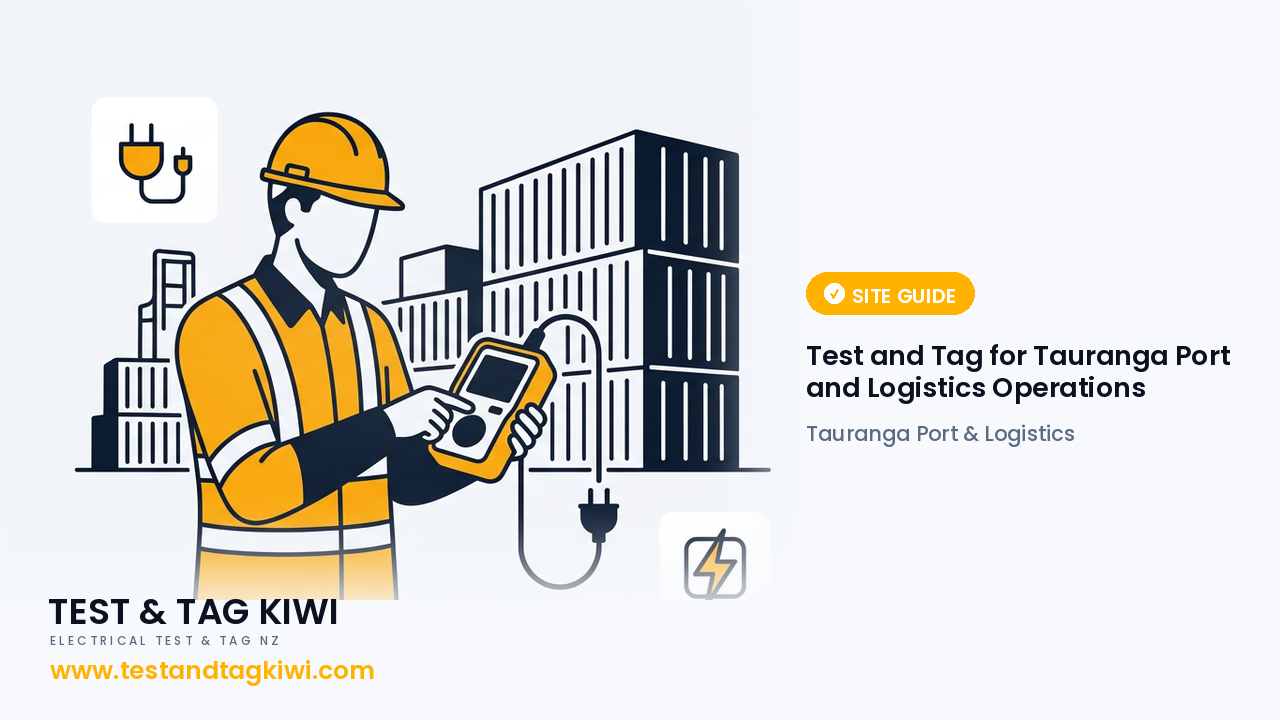
A port is not an office park, and it is not a quiet warehouse either. Tauranga is home to New Zealand's largest port, and the logistics operations that cluster around it run heavy plant, container handling equipment, refrigeration and temporary power in an environment that is wet, salty and hard on equipment. Gear is moved constantly, shared between crews, and plugged in and out all day. That mix is exactly why electrical safety on a port or logistics site deserves a plan of its own rather than a generic checklist borrowed from a shop or a school.
This guide looks at the electrical risks that are specific to port and logistics work in Tauranga and the wider Bay of Plenty, what the law actually asks of a business, and how to build inspection and testing into a shift operation without bringing it to a halt.
What the law actually asks of a port or logistics business
Start with a point that is widely misunderstood. Testing and tagging is not mandatory in New Zealand. No regulation says that every appliance must carry a tag. The duty under the Health and Safety at Work Act 2015 is broader: a business must ensure, so far as is reasonably practicable, that the equipment its workers use is electrically safe and kept in a safe condition.
Testing and tagging to AS/NZS 3760 is one recognised way of demonstrating that equipment is safe. It is a standard rather than a law, and it works best as a method that supports the duty rather than a rule that replaces it. Maintenance, visual checks, RCD protection and prompt repair all serve the same end. If you want the background on how the practice works, see what test and tag involves and the plain-English compliance guide.
Where electrical risk actually sits on a port or yard
Port and logistics operations concentrate a particular set of electrical hazards into a small area. The risks worth planning around include:
- Refrigerated containers and shore power. Reefers plug into shore power for long periods. Plugs, sockets and leads take constant handling in salt air, and a damaged connection is both a shock risk and an expensive outage.
- Container handling plant. Reach stackers, forklifts and mobile plant carry their own electrical systems and battery banks, and charging areas bring together high currents and, with lead-acid batteries, hydrogen gas.
- Portable tools and extension leads. Angle grinders, impact drivers, powered lashing tools and work lighting are the classic candidates for flexible cord and plug damage.
- Temporary and outdoor power. Wash-down bays, workshops and hardstand sockets work in wet, exposed conditions where RCD protection earns its place.
- Contractor and visiting equipment. Drivers, stevedoring crews and contractors bring their own gear on site, which makes ownership and inspection status harder to track.
Salt, water and wear: why the marine setting changes things
Salt-laden air is the defining feature of a Tauranga port. It corrodes exposed metal, hardens cable insulation over time, and attacks the pins and contacts inside plugs and sockets. Add regular wash-down and rain, and equipment ages faster than it would well inland. That is not an argument for testing more often for its own sake, because the recommended intervals in AS/NZS 3760 already take the environment into account, but it is a strong reason to take routine visual inspection seriously and to act quickly on the kind of damage salt and water produce. A damaged cord is cheaper and safer to deal with early than after it fails.
Reefers, charging bays and other plug-in loads
Two areas of a logistics site repay close attention. The first is the reefer rack and any shore-power position. Plugs and sockets here are handled hundreds of times a season, often with wet or gloved hands, and the cables run across surfaces that see vehicle traffic. The second is the battery charging bay. Charging areas mix electricity, heat and, for lead-acid batteries, hydrogen, so ventilation, the condition of leads and connectors, and the protection of charging circuits all matter. Neither area is exotic, but both benefit from being on a defined inspection route rather than being left to whoever plugs in next.
Three layers of protection: user checks, inspection and testing
It helps to think of electrical safety on site as three layers that work together.
- Pre-use user checks. The person about to use a tool or lead looks it over: cracked casing, damaged insulation, a bent or discoloured pin, a plug that feels loose, or a missing tag. This is a few seconds of attention and it catches most serious damage before it reaches a worker.
- Periodic visual inspection. A scheduled walk-round of leads, tools, RCDs and fixed connections, recorded against the asset, that catches the slow deterioration salt and water cause.
- Formal inspection and testing. Instrument testing of the equipment and its insulation, plus the operation of RCDs, at intervals set by the environment and the equipment type as described in AS/NZS 3760.
Testing is the layer organisations remember, but it is the smallest of the three in day-to-day terms. The user check is what stands between a damaged lead and an injury.
Building testing into a shift operation
The common objection to a testing programme on a busy site is downtime: it seems the crane cannot stop so a lead can be tagged. The answer is that testing does not require stopping the whole operation. Sensible scheduling for a port or logistics yard usually means:
- Grouping equipment by area and asset owner so a tester moves through a yard once rather than repeatedly.
- Testing during planned maintenance windows, shift changeovers and quiet periods rather than peak throughput.
- Keeping a pool of tested spare leads and tools so a failed item can be withdrawn and replaced on the spot.
- Tagging and recording as you go, so the equipment's status is visible to the next person who picks it up.
For a larger site, a structured programme along these lines is covered in how to set up a test and tag programme.
Record keeping across a large, mixed fleet
On a site where gear is shared, hired and brought in by contractors, the record is as important as the test. An asset register that lists each item, its location, its last inspection and its next due date turns an invisible obligation into something you can act on. It also settles the practical questions that come up constantly: whose lead is this, when was the RCD last checked, and which items are overdue. Our guides to record keeping and to asset register management cover how to set this up.
RCDs: the layer that matters most outdoors
Much of the risk on a port or yard involves portable equipment used in the open. RCD protection is the backstop for that equipment: if a lead or tool develops a fault, an RCD is designed to cut the supply quickly enough to prevent a serious shock. RCDs are not fit-and-forget, though. They need to be checked for correct operation, and a damaged or tripping RCD means replace, not reset and hope. RCD testing and the explanation of how RCD protection works cover what to look for.
Repairs and who may carry them out
When a lead or tool fails, the cheap instinct, which is to tape it up and put it back, is the wrong one. Repair of electrical equipment is prescribed electrical work under the Electricity (Safety) Regulations 2010, and it needs to be done by someone appropriately qualified. On a port or logistics site the practical version of that rule is simple: withdraw the item, tag it out of service, and either have it repaired properly or replace it. A tagged-out item that is never repaired should be removed from the pool so it does not drift back into use.
Doing it in-house or engaging a provider
Some sites run their own inspection and testing with trained staff; others bring in a specialist provider. Both are legitimate. In-house gives you flexibility and quick turnaround if you have trained people and the right instruments. A provider suits sites that want the testing, tagging and reporting handled together, and can be cost-effective where a fleet is large or spread across several locations. Cost is driven by the number of items, their type and the access involved, and our guide to what drives test and tag cost sets out the factors. To talk through a Tauranga site specifically, you can request a quote.
Getting started on a Tauranga port or logistics site
The practical starting point is an inventory. Walk the site, list the leads, tools, RCDs, fixed connections and charging points, note where each is used, and score each area for how hostile the environment is. From there you can group items, set realistic intervals and put a simple record in place. If you would rather have the assessment and the programme set up for you, our Tauranga team and our warehousing and logistics service are set up for exactly this kind of site. The goal is not more stickers. It is electrical equipment that is genuinely safe and provably maintained.