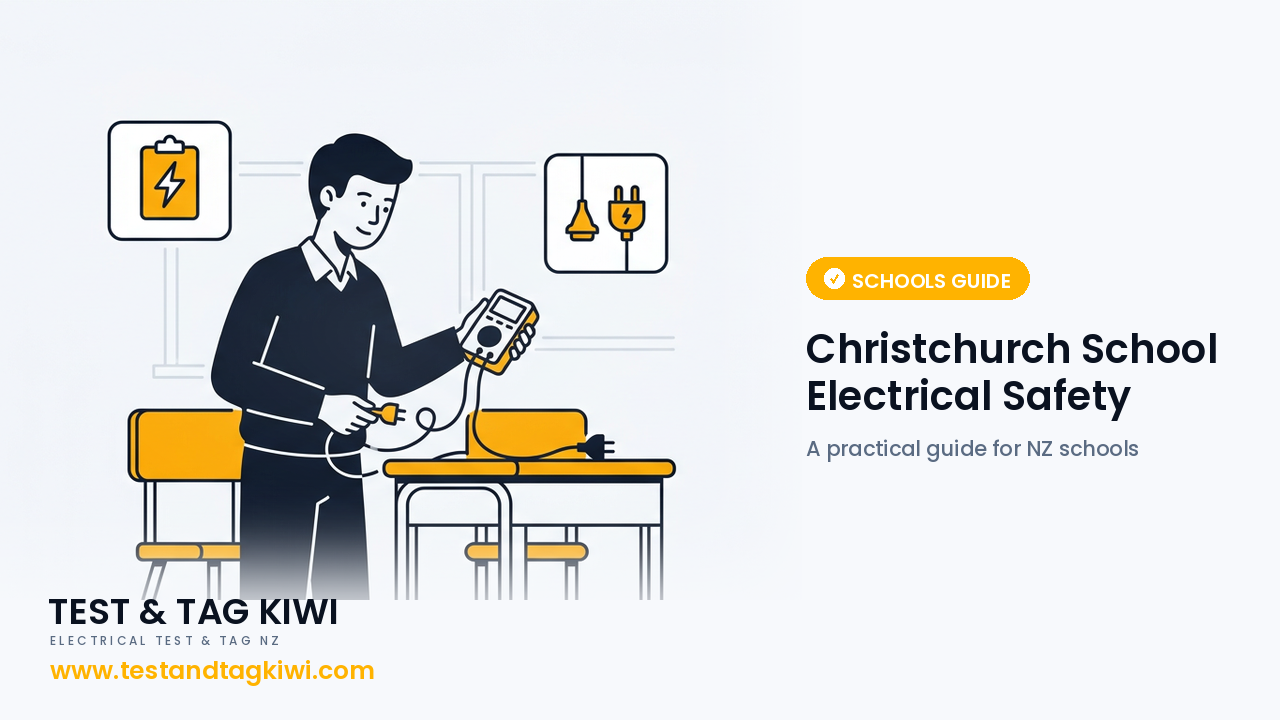
Why a school needs its own electrical safety approach
A school is not an office and it is not a factory. It is a busy, populated place where hundreds of people move through the same rooms every day, where equipment is shared and shifted constantly, and where a large part of the electrical load is plugged in and unplugged by people who are not electricians. That mix is why electrical safety in a school deserves a plan of its own, rather than a generic workplace checklist borrowed from somewhere else.
The starting point is the same as anywhere in New Zealand. Testing and tagging is one useful way to check that electrical equipment is safe, but it is not mandatory. What is legally required is that equipment is electrically safe and maintained in a safe condition. Everything below is about meeting that duty sensibly in a Christchurch primary, intermediate or secondary school.
What the law asks of a New Zealand school
Under the Health and Safety at Work Act 2015, the organisation that runs the school is a person conducting a business or undertaking (PCBU). For a state or state-integrated school that is the board of trustees; for an independent school it is the governing body. The duty is to ensure health and safety so far as is reasonably practicable, and that includes the electrical equipment staff and students use every day.
WorkSafe New Zealand does not ask schools to test and tag. Its published guidance describes testing and tagging as one way to check that equipment is safe, and leaves the decision to the school as the PCBU. AS/NZS 3760 is the Standard a school can choose to follow to demonstrate that its equipment is being checked in a structured way. It is a standard, not legislation, and it sits beside the guidance rather than above it. If you want the wider picture of how law, standards and guidance fit together, our compliance guide and our explainer on AS/NZS 3760 are good companions to this article.
The equipment that makes a school different
A school's electrical inventory is broader than most workplaces of the same size, and it shifts with the curriculum. A single Christchurch secondary school might hold, across its buildings:
- administration and staffroom equipment — computers, printers, kettles, microwaves, heaters;
- classroom devices — laptops, projectors, interactive screens, desktop computers and chargers;
- technology and workshop equipment — hand tools, portable power tools, soldering irons, dust extraction;
- science laboratories — microscopes, hot plates, fridges, and fixed fittings that only a registered electrical worker may work on;
- food technology and staff kitchens — ovens, benchtop appliances and dishwashers;
- caretaking and grounds equipment — vacuum cleaners, floor polishers, mowers, line trimmers and pressure washers;
- audio-visual and hall equipment — amplifiers, stage lighting, portable sound and extension leads;
- gymnasium and hall equipment — scoreboards, portable heaters and retractable seating.
The list is not meant to be exhaustive. The point is that the risk is not spread evenly. Some of this equipment is fixed and only a registered electrical worker may work on it. Much of it is portable and moves between rooms, which is exactly where leads and plugs take the most punishment.
Where the real risks sit in a school day
Most electrical problems in a school are not dramatic. They build up quietly:
- Damaged leads and plugs. A cord that is yanked from the wall, run under a door or coiled tightly around a device will fail long before the appliance does. A damaged lead can look perfectly fine.
- Shared devices. Laptops, tablets and chargers move between classrooms, so nobody feels they own their condition. A charger that failed silently in one room turns up in another.
- Wet and outdoor use. Food technology rooms, science labs, caretaking work outdoors and any equipment used in damp conditions all carry a higher risk and need a higher level of protection.
- Extension leads used as permanent wiring. A lead that is meant to be temporary quietly becomes the long-term connection to a projector, a heater or a bank of computers.
- Overloading. Several devices crowded onto one power board in a room that was never wired for that load.
RCD protection: the layer that does not depend on a test tag
An RCD, or residual current device, monitors the current on a circuit and disconnects the supply when it detects a fault, in many situations where a person would otherwise receive a serious electric shock. It is a separate control from testing and tagging, and it matters on its own terms.
WorkSafe's guidance is that whether or not equipment has been tested and tagged, it still needs RCD protection in certain circumstances, such as outside in the damp. For a school that means outdoor and caretaking equipment, portable tools used around the grounds, and any equipment used where water is present. Schools typically meet this with three types of RCD: switchboard RCDs that protect a whole circuit, socket-outlet RCDs built into a power point, and portable RCDs fitted to a plug or power board. Portable RCDs are the one type that does not need an electrician to install. Our article on how RCD protection works goes into the detail.
One habit is worth building into a school's routine. An RCD's test button should be pressed regularly, and on portable units before use. A test button check is not the same as a full test of trip time and current, but it is a fast way to confirm that the device responds at all.
Running a programme around the school calendar
The single biggest practical constraint in a school is access. Classrooms are in use five days a week, halls and gyms are booked after hours, and interrupting a lesson to test a projector is rarely welcome. The workable approach is to group equipment by how it is used and schedule accordingly:
- Fast-moving, high-use items — classroom devices, leads and chargers — are best handled in a scheduled sweep that can happen outside teaching time.
- Fixed and heavier equipment — workshops, food technology, science — suits a planned visit, often in a term break when rooms are free and the equipment is not in use.
- Caretaking and grounds equipment can usually be checked when the grounds team is not on task.
Term breaks are the natural window for the larger sweeps. A programme that ignores the calendar ends up either disrupting teaching or never happening at all.
Managing equipment that moves between rooms
Schools lose track of portable equipment more than any other organisation of their size, largely because it genuinely moves. An asset register is the fix, and it does not need to be complicated: an identifier on each item, a record of where it normally lives, and a note of when it was last checked. For equipment that travels — laptops, projectors, portable tools — a scannable tag and a simple register take most of the guesswork out. Our guide to test and tag records and record-keeping and the QR asset tracking service explain how that works in practice.
Records that make a school defensible
The value of a record is that it lets the school show what it did and when. WorkSafe recommends documenting the results when equipment is tested or inspected, and keeping those results accessible. In a school that record also answers a parent or board question quickly: which equipment was checked, who checked it, and what was found.
Good records are simple. They note the item, the outcome, the date and the next due date. Failed equipment is removed from service immediately, and that is the one action that cannot wait. Repairs to electrical equipment are prescribed electrical work, so only a registered electrical worker should carry them out, and the item should carry the correct tag once it is repaired.
A practical checklist for Christchurch schools
Every school is different, but a few steps apply across all of them:
- Decide who owns electrical safety on site and make it one named role, not "everyone".
- Build one list of electrical equipment and where it normally lives.
- Set a check frequency by risk, with higher-risk and outdoor equipment checked more often than a desktop computer in an office.
- Confirm RCD protection for outdoor, damp and portable-tool use.
- Give staff a simple way to report a damaged lead or plug, and remove faulty items immediately.
- Schedule the larger sweeps into term breaks.
- Keep the results together and review them before the next cycle.
Christchurch adds its own texture. The city's schools include buildings of many different vintages and layouts, with a correspondingly mixed set of installations, halls and specialist rooms. Working out what is fixed and what is portable, and where RCD protection already sits, is a useful first exercise before any testing begins.
Common mistakes schools make
- Assuming a visual check is enough, when a damaged cord can look intact.
- Testing everything on one rigid interval rather than by risk.
- Letting the register go stale so nobody knows what equipment even exists.
- Leaving extension leads in place as permanent connections.
- Forgetting outdoor and caretaking equipment, which often carries the highest risk.
- Treating testing and tagging as the whole programme rather than one layer beside RCD protection and regular visual checks.
Getting a school programme right
A school does not need to test and tag every item itself, and it does not need to test and tag at all to meet its duty. What it does need is to be able to show that its equipment is safe and maintained that way. Most Christchurch schools find a mix works best: a documented schedule, routine visual checks by staff, RCD protection where it is needed, and periodic testing either in-house or through a provider.
If you would like help setting that up, our test and tag service and RCD testing service cover Christchurch schools, and our schools page sets out how we work with education sites. You can also read what is involved in setting up a test and tag programme, or see our wider Christchurch coverage.