Why manufacturing needs its own testing plan
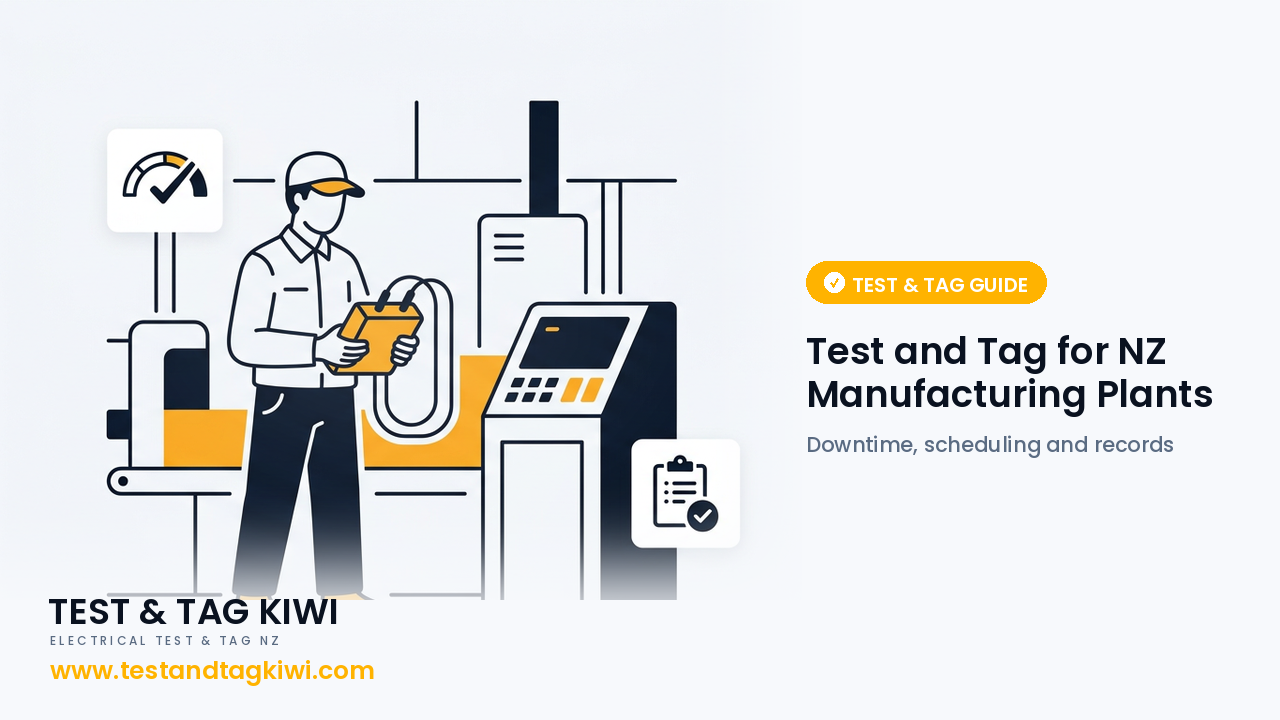
A manufacturing plant is not an office with more power points. Equipment runs long shifts, moves between benches, sits in dust, heat, coolant and vibration, and is often bolted down rather than carried around. When a production line stops, the cost is not one appliance — it is output, idle staff and downstream orders. Electrical safety planning in a factory therefore has to do two things at once: keep people safe around the equipment, and keep production running.
This guide is for production managers, maintenance engineers, health and safety coordinators and operations leads in New Zealand manufacturing businesses. It covers how to plan inspection and testing around production, how to separate fixed machinery from portable tools, and how to record the results so the plant can show it manages electrical risk deliberately.
What the law does and does not require in a factory
Four ideas are routinely blurred together in online advice, and keeping them separate decides where your effort should go: law, standard, guidance and best practice.
The law in New Zealand is the Health and Safety at Work Act 2015 and the Electricity (Safety) Regulations 2010. The duty they place on a person conducting a business or undertaking is that electrical equipment is electrically safe and maintained in a safe condition. Testing and tagging is not mandatory in New Zealand, and that is true whether you run a small workshop or a large plant.
Testing and tagging is one recognised way of checking that equipment is safe. AS/NZS 3760 is a Standard — a method a business can choose to follow so that inspection and testing are done consistently and the results mean something. WorkSafe New Zealand publishes guidance describing it as one useful way to check equipment is safe. Everything else — how often items are checked, what is tested first, how much is documented — is a decision you make based on your equipment and the risks around it.
That framing matters on a factory floor. Because testing and tagging is not itself a legal duty, the goal is not to prove obedience to a rule. It is to demonstrate that you understand how electricity could hurt someone in your plant and that you are acting on it. A well-run programme is evidence of that; a wall of expired tags is not. For the technical detail behind the Standard, see AS/NZS 3760 explained for New Zealand workplaces.
Fixed machinery versus portable equipment
The single most useful split in a plant is between equipment that stays put and equipment that travels.
Fixed equipment — larger machines, control panels, hard-wired production assets — is generally the domain of a qualified electrician rather than a portable-appliance tester. Inspection here looks at the physical condition of supply cables, isolators, guards and enclosures, and any repair is prescribed electrical work under the regulations. The condition of this equipment is usually picked up through a planned maintenance regime rather than a tag-and-test round.
Portable and transportable equipment is where routine inspection and testing pays off most. Hand tools, extension leads, bench lights, welders, portable fans, lead reels, battery chargers and small machines get knocked about, dragged across floors and used in wet or dusty areas. These are the items that move between workstations, so their history is only meaningful if their identifier travels with them. A scheme of QR asset tracking lets a technician or supervisor scan an item and see its full history on the spot, which is far more reliable than a faded hand-written label.
Start by deciding which category each item falls into, because that decision drives who tests it, how often, and what records you keep. A structured electrical risk assessment is the cleanest way to justify the choice item by item.
Scheduling testing around production
In a plant, the schedule is the hard part. Testing a single office can happen any quiet afternoon; testing a production floor has to fit around shift patterns, changeovers, planned shutdowns and customer deadlines. Three practices make it work.
- Batch by area, not by item type. Walking a whole production cell in one pass is far cheaper and less disruptive than chasing the same type of tool across the whole factory.
- Use natural stoppages. Changeovers, planned maintenance windows, seasonal shutdowns and night-shift lulls are the cheapest times to test. Align electrical work with maintenance you are already scheduling so production is only interrupted once.
- Give floor staff notice. A short brief to supervisors beforehand means equipment is gathered, accessible and not in the middle of a job when the tester arrives.
Where a plant runs continuous shifts, a rotating plan that tests one area per visit spreads both the disruption and the cost. Consistent grouping also makes it easier to report compliance across the whole site rather than chasing records area by area.
Planning downtime without stopping the plant
The fear that stops many plants from testing is lost production. The answer is not to skip it but to plan it.
Most inspection and testing of portable equipment needs only the item briefly out of service, not the line stopped. Grouping the work by area and slotting it into an existing maintenance window usually removes the need for any extra downtime at all. For larger fixed assets that genuinely need isolation, choose the window deliberately: a planned outage booked weeks ahead costs far less than an unplanned failure that takes a line down mid-shift.
It also helps to prioritise. If you cannot get to everything at once, start with equipment that has the highest chance of hurting someone: items used by many people, equipment in wet or dusty areas, portable tools that are moved constantly, and anything near heat, coolant or metal swarf. Fixed, rarely used equipment in a clean, dry area can wait. Documenting why you chose that order shows the sequence was a considered decision about risk.
Asset registers and records that hold up
Everything above depends on knowing what equipment you have. A workable asset register records, for each item, a unique identifier, a plain description, its location in the plant, who is responsible for it, the interval that applies, and the date it was last checked and is next due.
The identifier is the part plants most often get wrong. A tag number that is unique across the whole site — not just within one bay — is what lets an item move between areas without losing its history. A central register keeps up with equipment being bought, retired or transferred, rather than decaying into a spreadsheet nobody trusts. A managed asset register service can carry that load for a growing plant.
Keep the same records for every item: what was inspected, what was tested, the result, the date, who did the work, and what was done with anything that failed. Storing them centrally means a supervisor, an insurer or a customer can be answered without a hunt. The principles are set out in test and tag record keeping for NZ businesses, and a multi-site dashboard turns that data into an at-a-glance view of which areas are current and which are overdue. When an item does fail, knowing what happens next — described in what happens when equipment fails a test and tag — should be part of the plan, not an afterthought.
Common pitfalls in manufacturing plants
- Treating the whole plant like an office. Fixed machinery and portable tools need different handling, different people and different intervals.
- One interval for everything. Convenient, but it overspends on low-risk items and under-protects the ones used in harsh conditions.
- A register that only exists on paper. If it is not updated when equipment moves or is retired, it stops matching the floor within months.
- Testing around the plant instead of inside it. Grouping by area and using maintenance windows cuts disruption far more than a national schedule applied to every bay.
- Treating the tag as the goal. The tag records that a check happened. What protects people is acting on what the check found.
A practical checklist for manufacturing plants
- Sort equipment into fixed assets and portable/transportable items, and record which is which.
- Build one asset register with a unique identifier per item, unique across the whole site.
- Set intervals by equipment type and environment, and write down the reasoning.
- Group testing by area and slot it into existing maintenance windows or changeovers.
- Standardise how results are recorded, and store everything in one place.
- Prioritise the highest-risk equipment first when you cannot cover everything at once.
- Review the register and records on a fixed rhythm, and act on what they show.
If you would like help building or consolidating an inspection and testing programme across a production site, you can request a quote or get in touch with our team to talk through your plant. To see the broader picture for multi-site operations, the guide to running a multi-site test and tag programme is a useful next step.