Who owns electrical safety in a managed building?
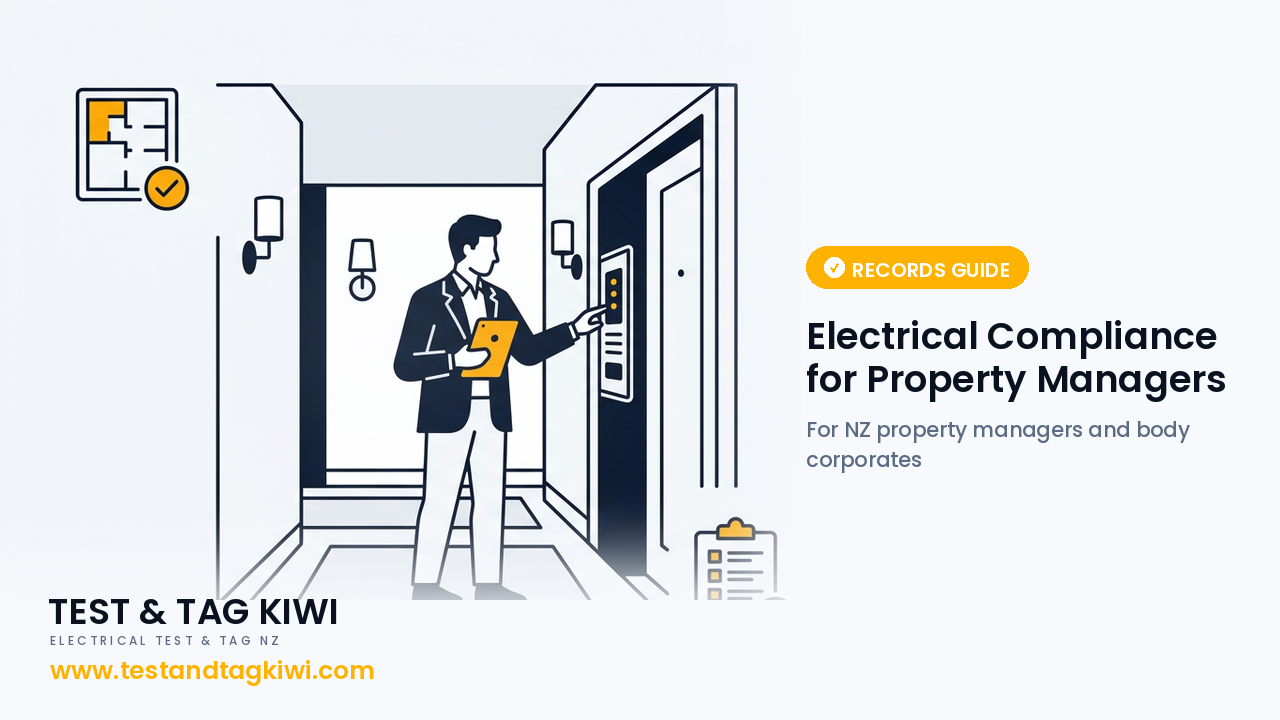
When you manage a property — whether you look after a portfolio as a professional property manager, or sit on a body corporate committee responsible for a shared building — electrical safety lands on your desk whether you asked for it or not. Tenants expect the power points, lights and appliances to work safely. Owners expect the building to stay safe and insurable. And when something goes wrong, the first question asked is usually who was responsible for checking the equipment.
This guide explains how electrical compliance works in managed properties in New Zealand: what the law actually says, which equipment is in scope, and how to set up a testing programme that produces records you can rely on. It is written for people who manage buildings, not for electricians.
What New Zealand law actually requires
The most important thing to understand is the difference between what is law, what is a standard, and what is guidance or best practice. These four are often blurred together in online advice, and the distinction matters when you are deciding where to spend money.
The law in New Zealand is the Health and Safety at Work Act 2015 and the Electricity (Safety) Regulations 2010. The legal duty is that equipment is electrically safe and maintained in a safe condition. There is no legal requirement to test and tag.
Testing and tagging is one useful way to check that equipment is safe. It is not a legal duty in itself. AS/NZS 3760 is a Standard — a recognised method a business can choose to follow so that equipment is inspected and tested in a consistent way. WorkSafe New Zealand publishes guidance explaining that testing and tagging is a helpful check rather than an obligation. Keeping those layers separate is what lets you make a sensible, defensible decision about your building.
So what does that mean in practice for a property manager? It means you are not breaking the law simply because a kettle has not been tagged. It does mean you carry a duty of care to the people who use the building, and a documented testing programme is one of the cleanest ways to show that duty is being met.
Who is responsible: owner, body corporate or tenant?
Responsibility in a managed property is not always obvious, because several parties interact with the same building.
- The owner — or the body corporate, for shared property — is generally responsible for the electrical safety of the building's fixed installations and the common areas.
- The tenant is generally responsible for the equipment they bring into the property and use in their own business.
- The property manager sits between them, and in practice is the person who coordinates access, schedules the work and keeps the records.
The boundary is easiest to draw around what the equipment is and who uses it. A tenant's own power tools are their responsibility. The building's fixed lighting, switchboards and shared appliances in common areas are the owner's or the body corporate's responsibility. For a deeper look at how a business should structure its own programme, see how to set up a test and tag programme.
Common areas versus tenanted units
Managed buildings have two distinct zones of electrical equipment, and each needs its own thinking.
Common areas
Common areas usually carry the equipment with the most public exposure: corridor and stairwell lighting, lift and plant-room supplies, shared kitchens and laundries, car park and external lighting, and any appliances provided for shared use. Because these areas are used by residents, visitors and contractors, a fault here can affect people who have no ability to inspect the equipment themselves.
Tenanted units
Inside a tenanted unit the fixed wiring belongs to the building, but the appliances usually belong to the tenant. That split is worth documenting, because it determines who arranges and who pays for testing. A commercial office fit-out, a café, or a workshop each introduces different equipment and different risks.
The equipment you will find in a managed property
The equipment mix in a managed building is broader than most people expect. Typical items include:
- Portable appliances supplied for shared use — vacuum cleaners, kettles, microwaves, irons in a communal laundry.
- Extension leads and power boards used by cleaners and maintenance staff.
- Fixed appliances such as hand dryers, water heaters and air conditioning units.
- Outdoor equipment — garden tools, pressure washers, external lighting and car park equipment.
- Contractor equipment brought on site for maintenance and repairs.
Anything that is plugged in and used in the building is a candidate for a visual check, and where a programme is in place, for periodic testing. If your building includes higher-risk settings, the same principles scale up — our guide to electrical risk assessment explains how to prioritise.
How a managed-property testing programme works
A programme does not have to be complicated. The aim is a repeatable routine that covers the building, records what was done, and surfaces problems before they become incidents.
- Build an asset list. Walk the building and note every item of electrical equipment, where it is, and who uses it. This is the foundation — without it you cannot schedule or prove anything.
- Assign risk. Note which items sit in harsher conditions or are used by the public. Equipment in a damp plant room or used outdoors generally needs more attention than a desk lamp in a dry office.
- Set a testing schedule. Decide how often each category will be checked and tested, based on the equipment, the environment and how it is used.
- Arrange the testing. Either train a staff member who has the knowledge and skills to test correctly, or engage a third party to carry out the work.
- Record and tag. Log the result of every check and attach a tag showing the date and the outcome.
- Act on failures. Remove faulty equipment from use immediately, and arrange repair by a licensed electrical worker or replace it.
If you would rather have the record-keeping handled for you, our compliance reporting service is built around exactly this kind of schedule.
Setting the testing frequency
There is no single interval that applies to every building. Frequency depends on the equipment, the environment it is used in and the risk profile. A portable appliance used outdoors in damp conditions would need more frequent checking than a fixed appliance in a dry office.
The practical answer for a property manager is to group the building's equipment into a small number of risk bands and apply a sensible interval to each. WorkSafe guidance is clear that the appropriate frequency is a decision for the person conducting the business or undertaking, informed by how and where the equipment is used.
Records and reporting for body corporates
The record is where a compliance programme earns its value. A tag on an appliance shows that a check happened, but the underlying register shows the full picture: what equipment exists, when it was last tested, what the result was, and what was done about any failures.
For a body corporate, that register is also a governance tool. It lets the committee answer owner questions with evidence, plan budgets around known testing cycles, and demonstrate that the building is being managed responsibly. Retaining the records over time matters more than any single test result — see test and tag record keeping for what to keep and for how long. Our compliance reporting guide covers how to structure the reports themselves.
A practical checklist for property managers
- Walk the building and list every item of electrical equipment in common areas.
- Confirm who owns each item — building, owner or tenant.
- Check cords, plugs and tools for visible damage at regular intervals.
- Make sure any outdoor or damp-area equipment is RCD-protected.
- Set and document a testing schedule by risk band.
- Keep a register of results and tags.
- Remove faulty equipment immediately and arrange repair or replacement.
- Review the programme at least annually, or whenever the building's use changes.
Common mistakes
A few problems come up again and again in managed properties:
- Assuming testing is the whole story. Testing gives a snapshot of safety at the time of testing. It does not guarantee future safety, so routine visual checks still matter.
- Leaving common areas out. Shared equipment is often overlooked because no single tenant owns it, yet it is used by the most people.
- No asset list. Without a register you cannot schedule testing, prove it happened, or notice when new equipment appears.
- Using domestic multi-boards outdoors. A domestic multi-board is not the same as a compliant portable socket-outlet assembly, and it does not provide the protection a worksite needs.
- Ignoring failed items. A faulty appliance left in a cupboard is still a hazard. Take it out of use immediately.
When to bring in a professional service
Many property managers can handle the routine visual checks and the record-keeping in-house. Bringing in a professional service makes sense when the portfolio is large, when there are many sites to coordinate, when access needs to be scheduled around tenants, or when you simply want the register and reporting maintained to a consistent standard.
Testing itself does not require a registered electrical worker, but whoever does the work must have the knowledge and skills to do it correctly and to understand the Standards involved. Any repair a test reveals must be carried out by a licensed electrical worker. If you want the whole programme run for you, our test and tag service covers managed properties, and you can request a quote for your building.
The bottom line for property managers
Electrical compliance in a managed property comes down to knowing what equipment you have, deciding how often it needs attention, and keeping a record of what you did. Testing and tagging is one useful part of that picture, not a legal mandate. The buildings that stay out of trouble are the ones with a simple, documented routine that keeps running year after year.