What an RCD does, in one paragraph
A residual current device (RCD) constantly compares the current flowing out on the active conductor with the current returning on the neutral. In a healthy circuit those two currents are almost identical. If some current escapes to earth — through a damaged lead, a faulty tool, or a person — the balance tips and the RCD disconnects the supply within milliseconds. That is why New Zealanders often call it a safety switch. For more on how it protects people, our guide to what an RCD is and how it is tested covers the fundamentals.
Once you understand that job, the next question is practical: which type of RCD belongs where? New Zealand workplaces use three broad types, and they are not interchangeable. Each sits in a different part of the circuit, protects a different scope, and is checked in a slightly different way.
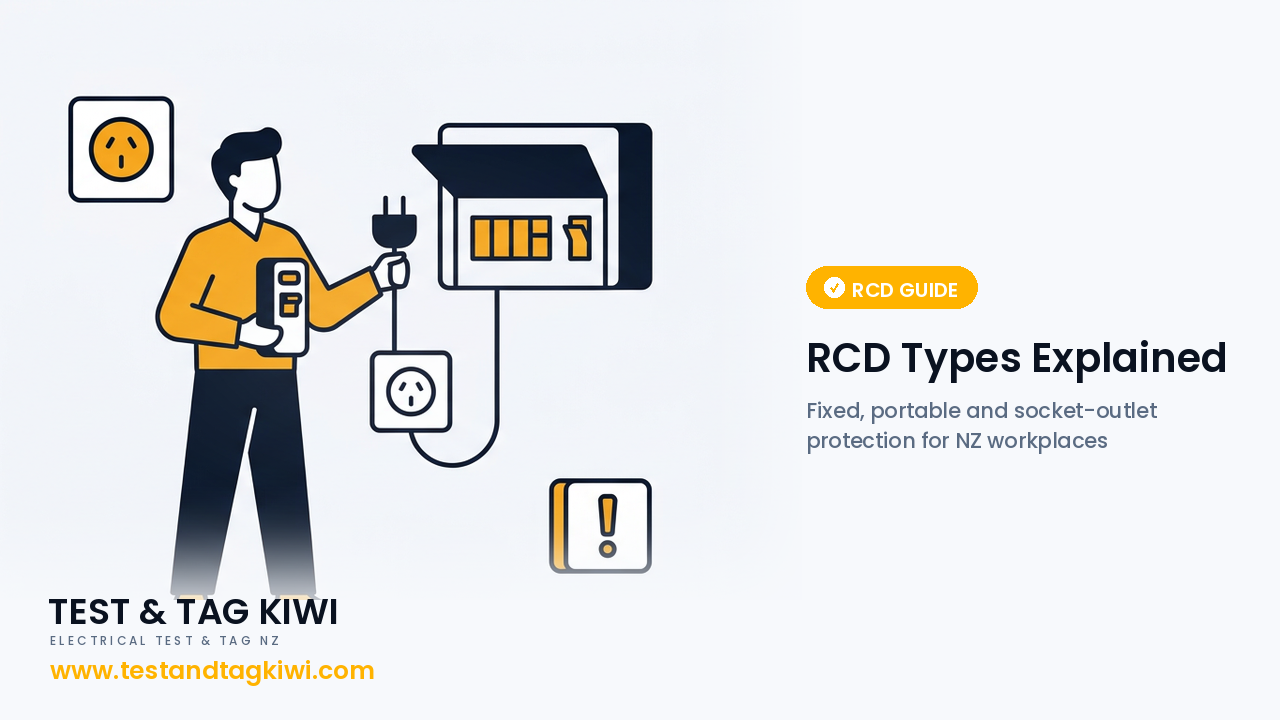
The three types of RCD you will see in New Zealand
Almost every RCD you meet in a workplace falls into one of these three categories. The difference is where the device sits in the circuit and how much equipment it can protect at once.
Fixed (switchboard) RCDs
A fixed RCD sits in the switchboard and protects a whole circuit or a group of circuits. Because it covers everything downstream, it gives broad protection with a single device — handy in a workshop, kitchen or office where many appliances share a circuit.
The trade-off is disruption. When a fixed RCD trips, it takes every appliance on that circuit down with it, which can make finding the faulty item harder. Installing or working on a fixed RCD is prescribed electrical work, so it must be carried out by a licensed electrical worker or electrical inspector.
Socket-outlet RCDs
A socket-outlet RCD is built into a single power point. It protects whatever is plugged into that one outlet, which makes it useful for isolating a specific piece of equipment or a single workstation without affecting the rest of the circuit.
Like a fixed RCD, a socket-outlet RCD forms part of the fixed installation, so a licensed electrical worker installs it. It is a common choice where a workplace wants protection at a particular point — a test bench, a laboratory, or a piece of equipment that is known to be sensitive.
Portable RCDs
A portable RCD (sometimes called a plug-in or inline RCD) plugs into an existing outlet and protects the equipment plugged in behind it. No electrician is needed to use one, and they are sold at hardware and electrical suppliers, which is why they are so common on building sites, for outdoor work, and for trades that move from job to job.
Portable RCDs are also found built into power boards and extension leads, and into portable socket-outlet assemblies (PSOAs) — the rugged multi-boxes used on construction sites. A compliant PSOA is a different animal from a household multi-board, and it comes with its own inspection requirements. Our guide to electrical safety on construction and demolition sites covers those in detail.
RCD, RCBO and circuit breaker: what is the difference?
These three devices are routinely confused, and the difference matters when you are deciding what to install.
- Circuit breaker (MCB) — protects the wiring from overload and short circuit. It does not detect the small earth-leakage currents that injure people, so on its own it is not a substitute for an RCD.
- RCD — detects earth leakage and disconnects the supply. It is there to protect people and to reduce fire risk from leakage currents.
- RCBO — combines both functions in a single device: the residual-current protection of an RCD plus the overcurrent protection of a breaker.
An RCBO is convenient because it gives one circuit both protections and, when it trips, it isolates that circuit alone. A fixed RCD covering several circuits will take them all down together. Which arrangement suits your site is a decision for your electrician, based on how the installation is wired and how you use it.
Type AC and Type A: matching the RCD to the equipment
RCDs are also classified by the kind of fault current they can detect. Two types dominate general workplace use.
- Type AC responds to alternating residual current — the classic earth-leakage waveform.
- Type A responds to alternating residual current and to pulsating direct residual current, which can be produced by equipment with electronic power supplies, variable-speed drives, and modern appliances with switch-mode electronics.
As workplaces fill up with electronics, Type A protection has become far more common, because it covers fault currents a Type AC device may not detect. If your site runs equipment with electronic components, it is worth asking your electrician whether the existing RCD type still matches the load. This is a genuine safety question, not a housekeeping detail.
Which type should your workplace use?
There is no single right answer — the correct choice follows the risk, the equipment and the setting.
- Fixed or socket-outlet RCDs suit permanent workplaces where the same circuits are protected day after day: offices, kitchens, workshops, laboratories. They protect everything downstream without anyone having to remember to plug them in.
- Portable RCDs suit temporary and mobile work: construction sites, outdoor maintenance, trades moving between jobs, and any situation where the supply point changes. Because they travel with the worker, they protect the equipment wherever it is plugged in.
A practical rule of thumb is that portable protection is what you reach for when the location changes, and fixed protection is what you build in when it does not. Many workplaces sensibly use both.
How each type of RCD is tested
Whatever the type, there are two layers of checking: the quick push-button test that anyone can do, and the periodic instrument test that measures how the device actually behaves.
Daily test-button checks
RCDs should be test-button tested every day, or before use. Pressing the test button deliberately creates a small leakage current and should trip the device immediately. The test button confirms the mechanism still operates — it is the single cheapest check available, and it is the one most often skipped.
On construction sites this includes the RCDs on PSOAs, which should be test-button tested every day before use. A portable RCD should be checked the same way each time it is put into service.
Periodic instrument testing
The push-button test tells you the RCD trips; it does not tell you how fast, or at what current. A portable appliance tester or dedicated RCD tester injects a controlled fault current and records the trip time, comparing the result against the limits in the relevant Standard. This is the check that catches a device that has drifted out of specification while still appearing to work.
How often the instrument test is done is a risk decision, not a fixed national rule. A switchboard RCD in a quiet office and a portable RCD on a wet construction site carry very different risk profiles, and a sensible schedule reflects that difference. Our article on how often to test an RCD walks through how to set an interval that fits your environment.
RCDs, testing and tagging, and the law
It is worth being precise here, because the two controls are frequently muddled.
Testing and tagging is not mandatory in New Zealand. What is legally required is that equipment is electrically safe and maintained in a safe condition — that duty sits with the person conducting a business or undertaking under the Health and Safety at Work Act 2015. Testing and tagging is one accepted way to check equipment is safe; AS/NZS 3760 is the in-service inspection and testing Standard a business can choose to follow to demonstrate that. It is a standard, not legislation.
RCD protection is a separate control again. Equipment still needs RCD protection in certain circumstances — outdoors in damp conditions, for example — whether or not it has been tested and tagged. A current test tag on a lead says nothing about whether the circuit feeding it is RCD-protected. Our overview of the AS/NZS 3760 in-service testing Standard sets out where the standard ends and the Wiring Rules (AS/NZS 3000) begin.
Common mistakes to avoid
- Assuming a circuit breaker is enough. A breaker guards the wiring against overload; it will not detect the small leakage current that stops a heart. RCD protection is a separate layer.
- Skipping the daily push-button test. It takes seconds and it is the check that proves the device can still operate at all. Test results should be documented so there is a record.
- Fitting the wrong type for the load. A Type AC RCD protecting circuits full of electronic equipment may not respond to the fault currents those devices can produce.
- Treating a portable RCD as a permanent installation. Portable devices protect what is plugged in behind them. They are not a substitute for proper fixed protection.
- Confusing test and tag with RCD protection. They are two different controls. One checks the appliance; the other protects the circuit.
Building RCD protection into your safety programme
Getting the types right is only half the job. The other half is making the checks routine and recording them, so you can show what was done and when. A workable programme layers four things together: the right RCD type for each setting, daily push-button checks, periodic instrument testing on a risk-based schedule, and a simple record of the results.
If you would like help choosing the right mix of fixed, socket-outlet and portable RCD protection, our team can review your site and test and tag your RCDs as part of a broader electrical safety programme. You can also request a quote or read the compliance guide for the wider picture.