The short answer on RCD testing frequency in New Zealand
There is no single, legally fixed interval for testing a residual current device (RCD) in New Zealand. Testing and tagging is not mandatory, and no regulation sets a universal “test every so many months” rule that applies to every RCD in every workplace. What is required is that electrical equipment is electrically safe and maintained in a safe condition.
So the honest answer to “how often should an RCD be tested?” is: it depends. It depends on the type of RCD, how it is used, the environment it sits in, and the level of risk the work creates. What you can do is build a schedule that reflects good practice, is written down, and can be produced if a WorkSafe inspector, an insurer or a client ever asks what was checked and when. That is a defensible programme — and it is a risk decision, not a number handed down by law.
Two different things people mean by “RCD testing”
When New Zealanders talk about testing an RCD they usually mean one of two quite different activities. Keeping them separate is the first step to getting the frequency right.
1. The push-button test (the quick, day-to-day check)
Every RCD has a test button. Pressing it simulates a small fault and should trip the device, cutting the power. It takes seconds and needs no instruments. Guidance for construction sites states that RCDs — including the RCDs built into portable socket-outlet assemblies (PSOAs) — should be test-button tested every day, before use.
2. The instrument test (the periodic, measured check)
This is the test a technician performs with a dedicated RCD tester. It measures how quickly the device trips and at what current, and compares the result against the performance limits in the relevant standard. It is a fuller check than the push-button, and it is the one that produces a recorded result, a tag and paperwork.
The push-button test proves the mechanism moves. The instrument test proves it still operates within its trip parameters. A device can pass the daily button test and still fail a trip-time measurement, which is one reason the two are not interchangeable.
Daily and before-use checks
The daily push-button test is the foundation of any RCD routine. Before you plug in a tool, an extension lead or a PSOA, press the test button and confirm the RCD trips, then reset it. On a busy site this becomes part of the morning routine: check the RCD, check the lead, check the tool.
A failed button test is not something to work around. If the RCD does not trip, take the equipment out of service and have the device checked. Whether or not you test and tag, electrical equipment still needs RCD protection in certain circumstances, such as working outside in damp conditions — and an RCD that will not trip is not protection at all.
What drives the periodic testing interval
For the instrument test, several factors push the interval up or down:
- Equipment type and portability. A hand-held power tool that is dragged around and knocked about is exposed to more wear than a fixed appliance that never moves.
- Environment. Damp, dust, heat, vibration and outdoor use all stress equipment and cabling. Electrical equipment used on a construction site — outside and in damp conditions — needs more frequent testing than a computer in an office.
- Risk and consequences. The more people who use a device, and the harsher the setting, the more often it warrants checking.
- History. Equipment that has failed before, or has been repaired, may deserve a shorter interval.
- Regulatory or contractual context. Some contracts, insurers or site rules specify their own testing regime. Those are obligations you have agreed to — they are not the same as a legal mandate applying to every RCD everywhere.
RCD testing frequency on construction and demolition sites
Construction is the setting where New Zealand guidance is most specific, because the risks and the wear are highest. Under the guidance for electrical safety on construction sites:
- All electrical equipment on a small construction site should be RCD-protected — including kettles, microwaves and other domestic appliances.
- RCDs should be test-button tested every day before use, including the RCDs on portable socket-outlet assemblies.
- PSOAs (often called multi-boxes) must be tested by an electrician at least every three months.
- A builder’s temporary supply needs a periodic assessment at least every six months, with a qualified electrical worker issuing a Certificate of Verification confirming it complies with the relevant wiring and site standards.
These intervals come from standards and WorkSafe guidance written for site work, and they are what most site managers build their schedule around. They are not a universal rule that every RCD in every building must follow.
RCD testing frequency in general workplaces
Away from construction there is no published New Zealand interval that applies to every workplace. Offices, retail, hospitality and general industry are left to make a risk-based decision. In practice the pattern that works looks like this:
- Daily, or before use: push-button test on portable RCDs and PSOAs used for tools and temporary equipment.
- Regularly through the year: visual inspection of cords, plugs, RCDs and outlets for damage — a quick look costs nothing and catches obvious problems between instrument tests.
- Periodically, on a documented schedule: instrument test of fixed and portable RCDs. The interval is set by your risk assessment, not by a single national number.
- After any repair, or after a device trips unexpectedly: re-test before the RCD goes back into service.
A trades workshop or commercial kitchen with heavy tool use will sensibly sit at a much shorter instrument interval than a carpeted office. That difference is the risk assessment doing its job.
What AS/NZS 3760 does — and does not — say
AS/NZS 3760 is the standard for in-service inspection and testing of electrical equipment. It is a standard, not legislation. It is one option a PCBU can choose to follow to demonstrate that equipment is being maintained safely. Following it gives you a recognised, structured approach and a defensible record — but it is a choice, not an obligation imposed on every business.
For construction work, AS/NZS 3012 is the relevant guidance for the safe use of electricity on site. That is where the short site intervals sit. If you want the wider picture of how the standard, the regulations and WorkSafe guidance fit together, our compliance guide walks through it.
Do fixed, socket-outlet and portable RCDs need different frequency?
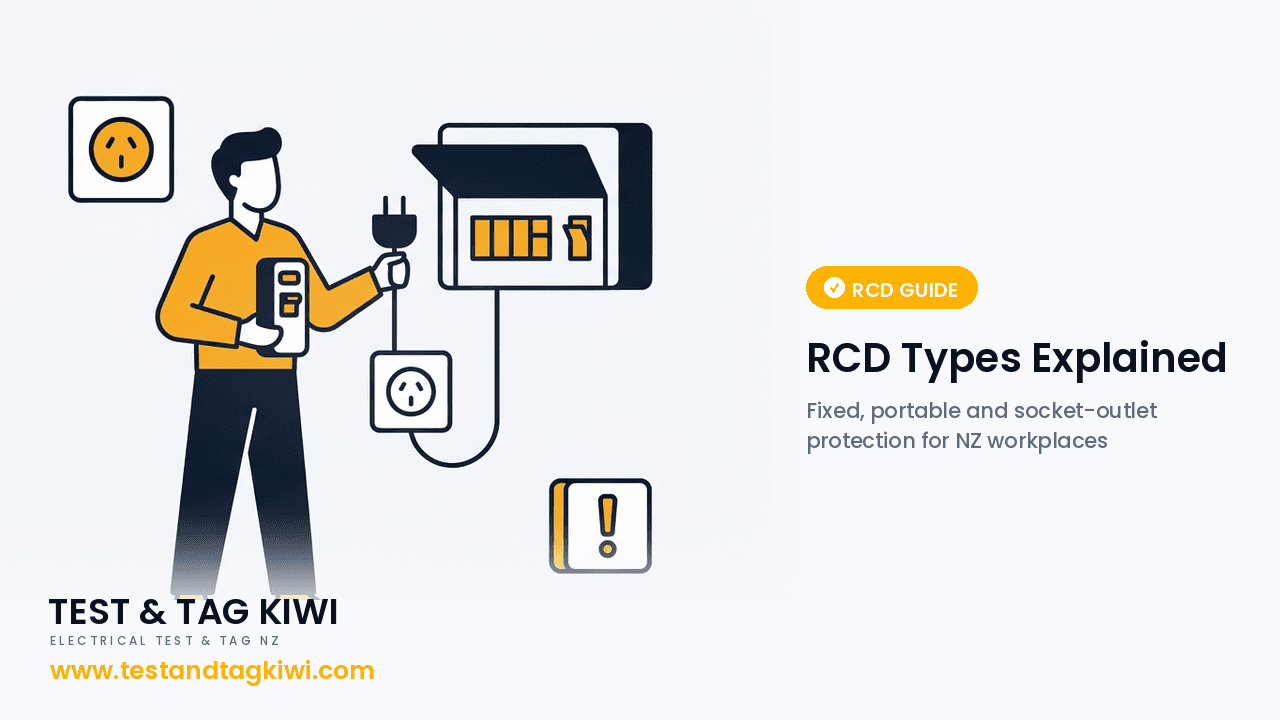
The three types of RCD behave differently and are maintained differently:
- Switchboard RCD — protects a whole circuit, and is installed by a licensed electrician or electrical inspector.
- Socket-outlet RCD — built into a power point; also installed by a licensed electrician.
- Portable RCD — plugs in, or is built into a lead or a PSOA; no electrician is needed to put it into service, and it is the easiest type to check daily.
Whatever the type, the same two layers apply: a frequent, simple functional check, and a less frequent, measured instrument test on a documented schedule. Fixed devices lean more on the scheduled instrument test, because nobody presses their button every morning. Portable devices get the daily check, because they sit in front of the worker at the start of every shift. For a fuller explanation of the differences, see what an RCD is and how it is tested.
Turning test results into a schedule you can defend
A testing frequency is only as good as the record behind it. Because testing gives a snapshot rather than a guarantee, the value comes from repeating it and documenting it. Keeping clear records means anyone can see what was checked, when, and by whom. A simple routine that works:
- List every RCD: location, type, and what it protects.
- Set a daily push-button check for portable RCDs and PSOAs.
- Set an instrument-test interval for each device based on its environment and use.
- Record the result of every test, and keep the results available on site.
- Tag or label devices so anyone can see when they were last checked.
- Remove faulty equipment immediately, and have it repaired by a licensed electrical worker before it returns to service.
If a device does fail, the sequence matters. What happens next — isolation, removal, repair and re-tagging — is set out in our guide to equipment that fails testing.
Common mistakes that undermine an RCD testing schedule
- Relying on the daily button test alone and never measuring trip times.
- Treating a company policy interval as if it were a national legal requirement — it is your standard, chosen for your risk profile.
- Skipping the check after a repair or an unexplained trip.
- Assuming an RCD means the equipment itself does not also need to be in safe condition — RCD protection and equipment condition are separate controls.
- Letting records drift, so nobody can say what was tested or when.
When to bring in a professional
Testing and tagging does not require a registered electrical worker, but whoever does the work must have the knowledge and skills to do it correctly and to understand the standards involved. Only a registered electrical worker can repair the faults that testing reveals. For fixed and socket-outlet RCDs, installation and electrical work are the domain of a licensed electrician.
If your schedule calls for instrument testing across a large or multi-site estate, a specialist provider can carry the load and hand you the records. Our RCD testing service is set up for exactly that, and pairs with a wider test and tag programme when you want one coordinated routine across a site.
Frequently asked questions
We answer the most common questions about RCD testing frequency below, including how often to press the test button and how the interval differs between an office and a construction site. For more general questions, see our FAQs.
Getting RCD testing frequency right for your workplace
There is no one number. There is a decision — made by the PCBU, informed by the equipment, the environment and the risk — and then the discipline of documenting and repeating it. Start with the daily button test, add a risk-based instrument interval, keep the records, and remove anything faulty immediately. That is a defensible programme whether or not you choose to test and tag.
If you would like help setting an interval that fits your site, and a documented routine you can rely on, request a quote or get in touch. We will help you match the frequency to your equipment and environment rather than guess.